
Severity and Priority in Software Testing
In software testing, not all bugs are equally important. Some bugs can stop the entire system from working, while others only affect small things like design or spelling. To handle these issues properly and release the software on time, teams use two key terms: Severity and Priority.
Many people confuse these terms, but they mean different things. Knowing the difference helps testers, developers, and managers decide which bugs need immediate attention and which can be fixed later.
What is Severity?
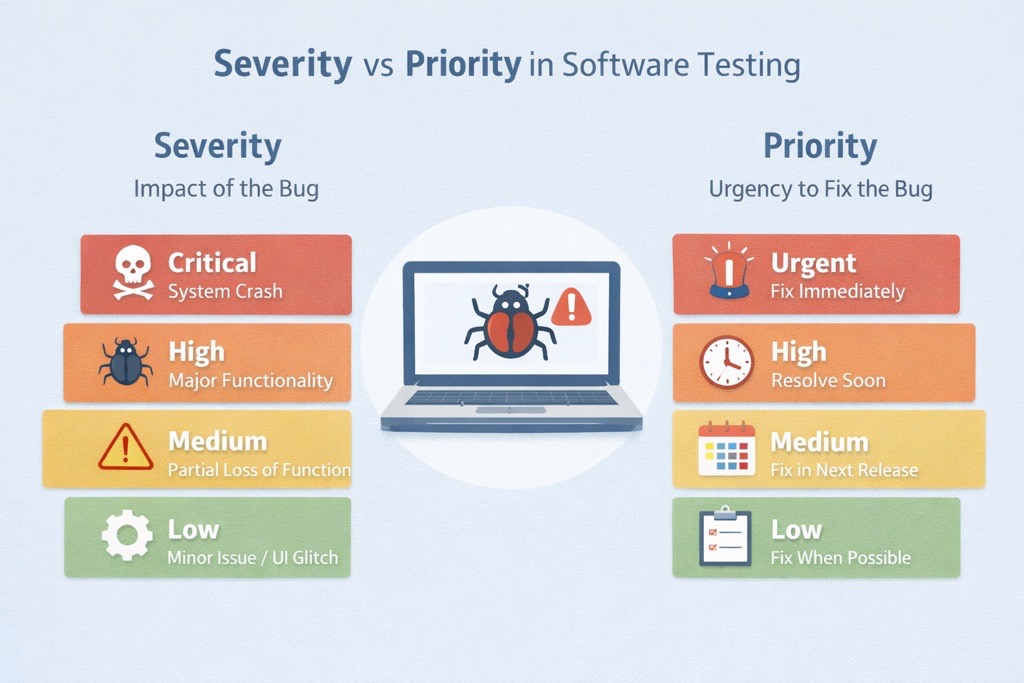
Severity refers to how much a defect affects the functionality of a system. It indicates the level of seriousness of a bug from a technical standpoint.
Severity is typically assigned by the QA or testing team, as they evaluate the extent to which the defect impacts the application’s performance and behavior.
Common Severity Levels
- Critical
- System crash
- The application becomes unusable
- High
- Major functionality is not working
- Medium
- The feature works incorrectly
- Limited impact on functionality
- Low
- Minor UI issues
- Typographical errors
- Cosmetic issues
Example: User cannot log in to the app when entering valid credentials; the defect severity is Critical.
What is Priority?
Priority refers to how urgently a defect needs to be fixed. It shows how soon the issue should be resolved based on business needs.
Priority is usually decided by the project manager, product owner, or business team, since it depends on customer expectations, deadlines, and release plans.
Common Priority Levels
- High
- Must be fixed immediately
- Affects business reputation or deadlines
- Medium
- Should be fixed in upcoming releases
- Low
- Can be fixed later
- Minimal business impact
Example: If a company logo is displayed incorrectly on the Homepage, the defect priority is High.
Real-World Scenarios
Imagine a banking application:
- A money transfer feature is failing → High Severity & High Priority
- A system crash occurs when it tries to generate a legacy export file → High Severity but Low Priority
- Typo in interest rate details on homepage → Low Severity but High Priority
- Background color slightly different from design → Low Severity & Low Priority
This shows how severity and priority do not always align.
Conclusion
Severity and Priority are fundamental concepts in software testing that help teams evaluate and manage defects effectively.
- Severity: Technical impact of the bug -> Critical, Major, Minor, Low
- Priority: How quickly it needs to be fixed -> High, Medium, Low
A successful software release depends not only on identifying bugs but also on understanding their impact and urgency. When applied correctly, severity and priority help teams make informed decisions, maintain high product quality, and deliver value to users on time.