
Understanding Requirements Analysis

A requirement can be documented, agreed upon, and still be unclear.
Consider a simple request: “The system should be fast.”
It sounds reasonable, doesn’t it? But how fast is fast? Does it mean loading a page within two seconds, generating a report within five seconds, or handling hundreds of users without slowing down?
A statement like this may seem straightforward, but it leaves room for different interpretations.
This is where Requirements Analysis becomes important.
While Requirements Gathering focuses on discovering stakeholder needs, Requirements Analysis focuses on examining those needs in detail and making them clear enough to guide development.
What Is Requirements Analysis?
Requirements Analysis is the process of examining requirements to understand their meaning, identify missing information, resolve inconsistencies, and determine what a solution needs to achieve.
A requirement isn’t necessarily ready for development just because a stakeholder has mentioned it.
Business Analysts need to look beyond the initial request, question unclear details, and work with stakeholders and technical teams to develop a shared understanding.
The goal is to turn general expectations into clear, practical, and testable requirements.
Why Is Requirements Analysis Important?
Even a well-developed system can fail to meet expectations if the requirements were misunderstood.
Effective Requirements Analysis helps teams:
- Improve Clarity: Ensure requirements are easy to understand.
- Identify Gaps: Discover missing details and overlooked situations.
- Resolve Conflicts: Address contradictory stakeholder expectations.
- Assess Feasibility: Understand whether requirements can realistically be implemented.
- Reduce Rework: Avoid unnecessary changes caused by unclear requirements.
In simple terms, analysing requirements helps teams understand exactly what needs to be developed before investing time and resources.
Understanding Different Types of Requirements
Not all requirements describe the same thing. Some explain what a system must do, while others describe how well it should perform.
Two important categories are Functional Requirements and Non-Functional Requirements.
Functional Requirements
Functional Requirements describe the features, functions, and behaviours a system must provide.
For example:
- The system shall allow registered users to log in.
- The system shall generate sales reports for a selected date range.
- The system shall notify the store manager when stock reaches a defined minimum level.
Simply put, functional requirements explain what the system should do.
Non-Functional Requirements
Non-Functional Requirements describe the quality attributes and constraints a system must satisfy, including performance, security, reliability, and usability.
For example:
- The system shall load the dashboard within three seconds under specified operating conditions.
- The system shall restrict administrative functions to authorized users.
- The system shall support 100 concurrent users while meeting defined performance targets.
While functional requirements define system capabilities, non-functional requirements help ensure those capabilities work at the expected quality level.
How Does a BA Analyse Requirements?
Once requirements have been gathered, a Business Analyst examines them to identify issues that could affect development.
Here are five important areas to consider.
1. Ambiguity
A requirement may have more than one interpretation.
For example, “The system should be user-friendly” is unclear because different people may have different expectations of usability.
2. Missing Information
A requirement may leave out important details.
If a stakeholder requests notifications, the BA needs to understand who receives them, what triggers them, and how they should be delivered.
3. Conflicting Requirements
Different stakeholders may have expectations that contradict each other.
For example, one department may request access to all reports, while another wants certain reports restricted. The BA helps stakeholders reach an agreement.
4. Dependencies
Some requirements depend on other features, services, or conditions.
For example, email notifications depend on having valid email addresses and a functioning email service.
5. Feasibility
Not every requested feature can be implemented within the available time, budget, or technical limitations.
A BA works with relevant team members to identify constraints and support realistic decisions.
By examining these areas, Business Analysts help make requirements more complete, consistent, and achievable.
Requirements Prioritization: What Comes First?
Imagine a project with 50 requested features but enough time to develop only 20. How should the team decide what to build first?
This is where Requirements Prioritization becomes useful.
Prioritization helps stakeholders identify which requirements are essential, which are important, and which can be postponed.
One commonly used technique is MoSCoW Prioritization, which groups requirements into four categories.
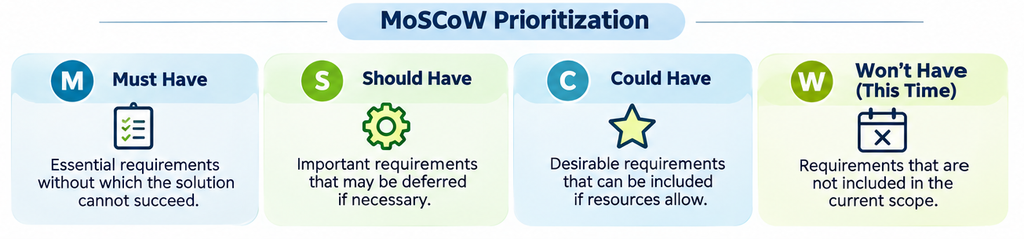
For example, in an online shopping system, placing orders and processing payments might be essential for the first release, while personalized product recommendations could be introduced later.
The purpose of prioritization isn’t simply to remove features. It’s to ensure that the most valuable and necessary requirements receive attention within the project’s constraints.
What Makes a Good Requirement?
A requirement should be understandable not only to the Business Analyst but also to developers, testers, and stakeholders.
Good requirements generally have the following qualities:
- Clear: Has one understandable meaning.
- Complete: Includes the necessary details.
- Consistent: Does not contradict other requirements.
- Feasible: Can realistically be implemented.
- Testable: Can be checked to confirm whether it has been met.
- Traceable: Can be linked to its source and business purpose.
Consider the following example.
Unclear Requirement: “The system should generate reports quickly.”
Improved Requirement: “The system shall generate a monthly sales report within five seconds for up to 10,000 sales records under defined test conditions.”
The improved version provides a measurable expectation that can be tested. The actual performance target should be agreed upon with stakeholders and checked for feasibility.
Requirements Validation: Are We Building the Right Thing?
After requirements have been analysed, one important question remains:
Do these requirements accurately represent what stakeholders need?
Requirements Validation helps answer that question.
It involves reviewing requirements with stakeholders to confirm that they reflect business needs and support the intended solution.
This may involve requirement reviews, discussions, walkthroughs, or prototype demonstrations.
While Requirements Analysis focuses on refining requirements, validation helps confirm that the resulting requirements are appropriate and agreed upon.
Conclusion
Requirements Analysis transforms gathered information into clear, meaningful, and practical requirements that can guide development.
By identifying gaps, resolving conflicts, assessing feasibility, and setting priorities, Business Analysts help teams make better decisions and avoid costly misunderstandings.
Because gathering requirements tells us what stakeholders are asking for. Analysing them helps us understand what the solution truly needs to achieve.